
Andrew Huberman. If you have not been living under a rock, you’ve likely seen his name associated with topics like dopamine, sunlight exposure and focus. He is a professor of neuroscience at Stanford University and has become a go-to figure in the realm of neuroscience-based self-improvement, and for good reason.
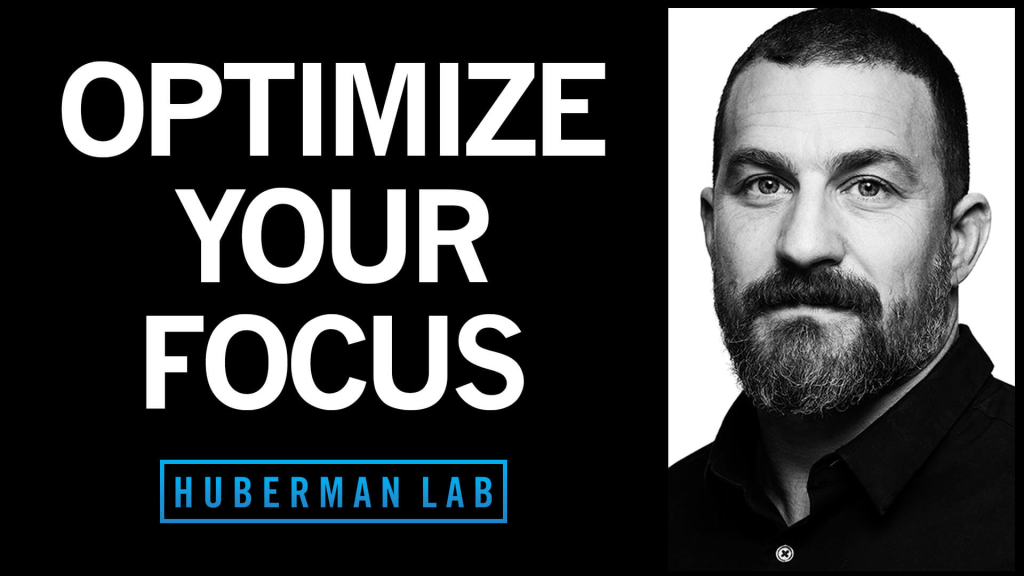
Have you ever noticed how quickly your mind wanders when you try to focus on a task? Our attention spans are in freefall, averaging just 8 seconds, a second less than a goldfish!🐟 Our attention, once our most valuable asset, has become the prized commodity that tech giants and corporations are actively trying to steal. Why? Simple. It makes them billions.
I recently came across Dr. Andrew Huberman’s podcast episode where he shared his “Focus Toolkit: Tools to Improve Your Focus & Concentration”. And I’ll be sharing insights from this episode.
So here’s exactly how you can reclaim your precious attention and get work done:
Step 1: Get Alert
Start your focus session by priming your body. Huberman recommends a breathing exercise to increase alertness:
– Take 25-30 deep breaths (in through the nose, out through the mouth).
– Exhale completely, then hold your breath for 15-60 seconds.
– Inhale deeply and hold until you feel the need to breathe again.
This breathing technique activates your nervous system and gets your body into a heightened state of awareness.
Step 2: Get Focused
Before diving into work, focus your eyes on a single point (like an object or a spot on the wall) for 30-60 seconds.
Now, these are tips to incorporate during work/study sessions:
1. Limit Focus Sessions to 90 Minutes or Less
After 90 minutes of deep work, your ability to concentrate naturally declines. Huberman recommends taking a short break after each 90-minute session to reset your focus. This break doesn’t need to be long—a few minutes can do the trick.
2. Listen to Frequency-Specific Music
Research shows that 40 Hz Binaural Beats can enhance focus. Huberman suggests listening to this specific frequency before or during your work sessions to help boost cognitive performance.
Here’s a 40 Hz Binaural Beats track to get started.
3. Incorporate NSDR After Learning Bouts
After each 90-minute work session, practice NSDR (Non-Sleep Deep Rest). NSDR promotes a state similar to deep sleep, increasing alpha and theta brain wave activity, which helps consolidate what you’ve learned.
Huberman’s own NSDR guides are great places to start:
4. Expect and Embrace Errors
Mistakes are part of the learning process. Huberman reminds us that errors are “terrific” because they promote growth. This mindset shift has been crucial for me. As a perfectionist, I’ve struggled with the idea of “good enough,” but embracing errors has allowed me to focus on progress over perfection. Without this change, I wouldn’t have launched this blog!
5. Insert Micro-Rest Intervals
Contrary to what you might hope, Huberman isn’t suggesting a 10-minute Netflix break. Instead, he advises taking 10-second pauses during your work session. These micro-rests help maintain focus and avoid mental fatigue.
6. Maximize Repetitions
To lock in what you’re learning, Huberman encourages maximizing repetitions during your learning sessions. The more you practice, the better your brain solidifies the information.
And I assure you, now, no Goldfish will ever be able to outfocus you!
 Chelsea Saydi
Leave a comment